




The single rule that matters most is that you stay covered from the waist down for the whole visit. Everything else follows from the fact that a hammam is a shared bathing room with a working routine, not a private spa treatment.
Here is the short version, then the detail.
- Keep the pestemal on. Full nudity is not permitted at the historic baths in Istanbul.
- Undress fully only in the changing cabin. Never in the hot room.
- Do not lie on the heated marble after the scrub. Rinse first.
- Do not use someone else’s kurna. The marble basins are claimed in the order people sit down.
- Say “yavas” if the scrub is too hard. Nobody is offended.
- Keep your voice down. Stone domes carry sound further than you think.
- No phones in the hot room. Assume photography is banned unless told otherwise.
- Tip in cash, by hand, at the end. Ten to twenty percent is the convention.
- Do not tip the reception desk instead. It goes to the attendant, in person.
What stays covered and what comes off
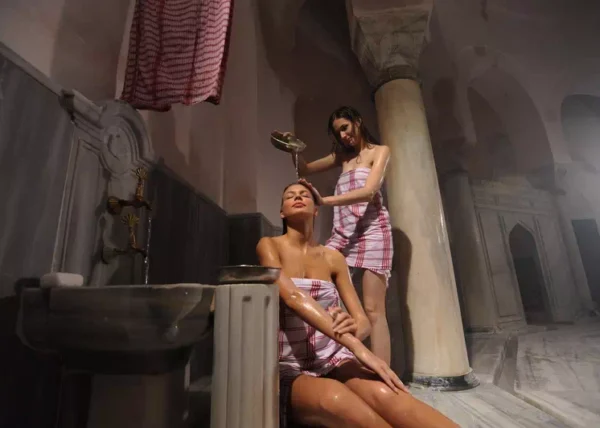
You undress completely in a private changing cabin, then wrap the pestemal, the woven cotton cloth handed to you at reception. From that moment the wrap stays on.
Men wrap the pestemal at the waist. Wearing swim shorts underneath is entirely normal and nobody comments either way, though wet cotton underwear becomes uncomfortable quickly.
Women keep underwear or a bikini bottom on beneath the pestemal. Tops are generally removed for the scrub, since the attendant works across the back and shoulders, and the room is women only at the baths that run separate sections. Some hammams include disposable underwear in the guest kit.
The rule against full nudity is stated explicitly by at least one of the historic baths and operated by all of them. This surprises visitors who expect a Nordic bathhouse convention, and it works the other way round here. More on what to bring is in what to wear to a hammam.
Jewellery, watches and contact lenses come off at reception and go in the locker. Metal heats up, and lenses become unbearable in that humidity within minutes.
How the room works
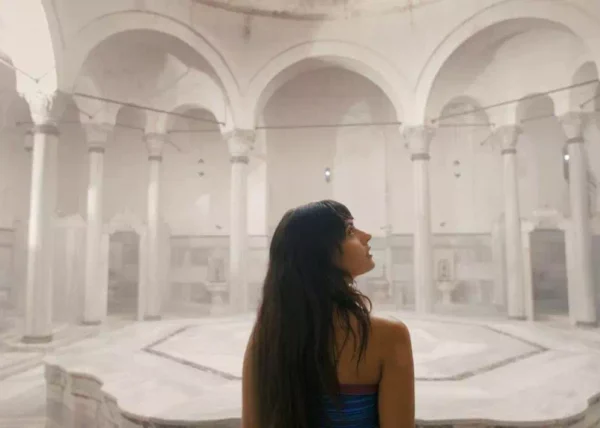
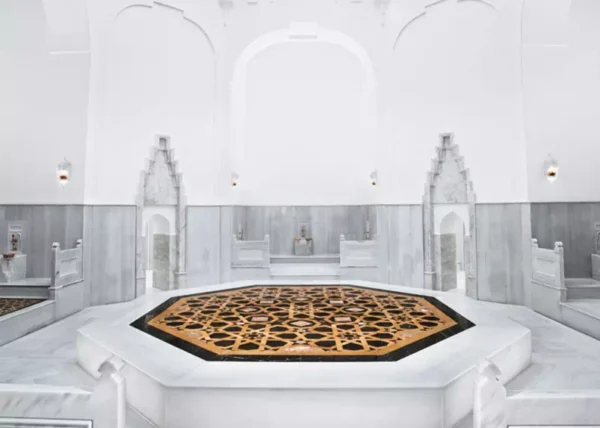
The hot room, the hararet, has a heated marble platform in the centre called the gobek tasi, and marble basins around the walls called kurnas. Knowing what each is for prevents most of the awkwardness first timers report.
The gobek tasi is for lying on before the scrub. You go there first, lie down, and stay for fifteen to thirty minutes while the heat softens your skin. Lie on your back or your front, leave space between yourself and other people, and do not put personal items on it.
The kurna is for washing. You sit beside it on the low marble ledge and use the copper bowl to pour water over yourself. Fill the bowl from the running tap, never dip it in the basin, and never get into the basin. The kurna is a water source shared by everyone in the room.
Basins are claimed by occupancy. If someone has left a bowl and soap at a kurna, it is taken. Move to another one.
Rinse before you return to the marble. After the kese, you are covered in the skin it removed. Going straight back onto the shared platform without rinsing is the most common breach of hammam etiquette committed by visitors, and it is the one regulars notice.
Dealing with the attendant
The attendant is the tellak for men and the natir for women. At the historic baths that run separate sections or separate hours, the attendant is always the same gender as you. At the one mixed bathhouse in the historic group, all attendants are male by policy, including for women, which is worth knowing before you book there rather than finding out at the door.
They will come to you. Do not go looking for them or try to catch their eye. When they are ready they will call you over, usually with a hand gesture toward a kurna. Until then, lie on the marble.
Follow the physical direction. They will move your arms, turn you over and position your head. This is the routine, done thousands of times, and resisting it slows everything down.
Say something if it is too hard. “Yavas” means slower or gentler and is universally understood. Attendants calibrate to what most guests want, which is firm, and they adjust immediately when asked. Not asking and enduring it is the worse option.
Tell them about skin problems first. Eczema, sunburn, a recent tattoo, a fresh shave or a cut all change how the kese should be used. Say so before the scrub begins, not during.
English is not guaranteed. Reception at the historic baths generally speaks it. Attendants in the wash rooms often do not. Gestures work, and so do the words yavas for gentler and tamam for that is fine.
Noise, privacy and behaviour
A hammam is a domed stone chamber and the acoustics are unforgiving. Conversation at normal volume carries across the whole room, and a raised voice fills it.
Turkish regulars treat the hammam as a social space and do talk. What they do not do is shout, sing, play music or conduct calls. The register to aim for is a restaurant, not a swimming pool.
Do not stare. It should not need saying and it is the most common complaint from women’s sections about visitors. People are semi undressed in a shared room. The convention is to look at the architecture or at nothing.
Do not photograph anyone. One historic bath prohibits photos and video in the washing and hot rooms outright, another permits them only in areas the management designates. Assume no cameras in the wet areas unless a member of staff tells you otherwise, and never photograph another guest under any circumstances.
Phones stay in the locker. Beyond the etiquette, the humidity is close to saturation and it will damage the device.
Do not shave, pluck or perform grooming in the hot room. This is a shared water space.
The full sequence, including what happens at each stage, is in the step by step process guide.
How much to tip at a hammam
There is no official rate and only one of the historic Istanbul baths publishes a policy at all, stating that tips are entirely optional.
The convention in practice is ten to twenty percent of the service price, given directly to the attendant who worked on you, in cash, in Turkish lira.
| Do | Do not |
|---|---|
| Bring lira in cash before you arrive | Try to add a tip to the card payment at reception |
| Keep it in your locker with your clothes | Bring cash into the wet rooms |
| Hand it to the attendant personally in the cooling room | Leave it on the marble or at the desk |
| Split it if two people worked on you | Assume the desk will distribute it |
| Tip after the service, not before | Tip in foreign currency, which is awkward to change |
The attendants come through the cooling room to say goodbye at the end, which is the moment this happens. It is not a demand, and nobody will pursue you if you do not.
Timing, booking and arriving
Book ahead. The historic baths work on reservations. One asks for around a week’s notice and cancels the booking if you arrive more than twenty minutes late. Another operates strictly by appointment with a non refundable deposit and asks for two or three days’ notice.
Check the gender schedule before you book. The baths handle this three different ways. Some have entirely separate men’s and women’s sections operating simultaneously. One is a single domed room split by fixed time slots, so women can only attend in the morning and men only from late afternoon. One runs a mixed hall for couples and families. Turning up in the wrong window means being turned away.
Arrive fifteen minutes early. Changing, locking up and the walk to the hot room all take time that is not part of your booked slot.
Do not schedule anything immediately after. A full visit runs ninety minutes to two hours and you need twenty minutes of cooling down at the end. Walking out of a hammam into a timed museum entry wastes the hammam.
Do not eat heavily beforehand or drink alcohol at all. The baths themselves advise against both, and the alcohol point is a genuine safety matter on wet marble.
Going as a couple or a group
Most of the historic hammams do not offer couples service, and at least one states so directly. The default arrangement is that a couple arriving together separates at reception and meets again afterwards.
The exception is the one historic bath that operates a mixed main hall for couples and families. There, couples receive the scrub and massage together in a shared historic space rather than a private room, and requests to be separated are declined. All attendants there are male. That combination suits some couples and not others, which is why it should be a decision made at booking. The formats are set out in the couples hammam guide.
Groups of friends going together is entirely normal and is what the women’s sections were built for. Book together so you are scheduled in the same slot.
Wedding parties have their own tradition and their own booking process, covered in bridal hammam traditions.
Rules the baths actually enforce
These are published policies rather than social conventions, and they vary between the historic hammams.
Pregnancy. Several decline pregnant guests outright, citing heat load and slip risk. Do not conceal it.
Age limits. One does not admit under sixteens. Another does not admit under sixes and requires an adult for anyone under eighteen. Children between four and twelve are charged a reduced rate at some baths and infants under three are free but not scrubbed.
Health conditions. Heart disease, diabetes and asthma appear on the advisory lists at more than one bath.
Menstruation. Not a restriction. At least one bath states directly that menstruating guests are welcome with appropriate sanitary protection.
Alcohol. Not served on the premises at the historic baths, and visiting after drinking is advised against.
Outside food and drink. Not permitted. Tea, water or sherbet is included.
Late arrival. Shortens your service at best and cancels the booking at worst.
What visitors get wrong most often
Expecting a spa. A historic hammam is a public bathing institution with a five hundred year old routine. The rooms are shared, the marble is hard, the scrub is firm and the atmosphere is functional rather than hushed. People who arrive expecting scented candles and whale song are disappointed for reasons that have nothing to do with the quality of the service.
Rushing the heat. The kese only works on skin softened by heat. Getting up after ten minutes because you are bored means a less effective and less comfortable scrub.
Forgetting dry underwear. The single most common practical mistake, made by men and women equally.
Going straight outside afterwards. Particularly in winter. Twenty minutes in the cooling room is part of the visit, not an optional extra.
Being embarrassed. Briefly, then not. The rooms are same gender at most of the baths, the wrap stays on, and the attendants have done this thousands of times. The part first timers find strangest is the visible dead skin from the kese, which is the expected result rather than a comment on your hygiene.
Booking a hammam in Istanbul
Choose the bath by what you want from it, then check the gender schedule for the day you plan to go, then book. The historic baths in the old city and Tophane fill on weekends and through the summer, and several of them cannot take walk ins at all.
Browse the baths and reserve your session here, with instant confirmation and free cancellation up to 24 hours before.
Frequently asked questions
Are you naked in a Turkish bath?
No. The historic Istanbul hammams do not permit full nudity in the bathing areas. Men wear a pestemal at the waist, women wear underwear or a bikini bottom beneath one. You undress completely only in the private changing cabin.
How much should you tip at a hammam?
Ten to twenty percent of the service price is the convention, handed to the attendant directly in the cooling room at the end, in Turkish lira in cash. Only one of the historic baths publishes a policy and it describes tipping as entirely optional.
Can men and women go to a hammam together?
At most of the historic baths, no. They run separate sections or separate hours and several state explicitly that they do not offer couples service. One historic bath operates a mixed hall for couples and families, with male attendants for all guests.
What should you not do in a hammam?
Do not remove the pestemal, do not get into the marble basins, do not return to the heated platform without rinsing after the scrub, do not photograph anyone, do not bring a phone into the wet rooms, and do not arrive having been drinking.
Is it rude to refuse the scrub or the massage?
No. You can book entry only at some baths and take the heat and the wash without the kese, and you can decline the oil massage, which is usually a separate charge anyway. Tell reception when you book rather than the attendant halfway through.
Do you talk in a hammam?
Yes, quietly. Turkish regulars treat it as a social space and conversation is normal. What carries badly in a stone dome is volume, music and phone calls.
How long should you stay in the hot room?
Fifteen to thirty minutes before the scrub, which is what the packages allow for. If you feel lightheaded, move to a kurna and pour cool water over yourself, or step into the cooling room. Nobody expects you to endure it.
What language do you need?
None. Reception at the historic baths speaks English. In the wash rooms, “yavas” for gentler and “tamam” for that is fine will cover almost every situation, and the routine is physical rather than verbal.

Comments 2
[…] visitors who want the customs explained before arriving should read hammam etiquette in Istanbul. Women visiting alone or in a group, especially at the female-staffed spa hamams, will find the […]