




Here is the short version, before the detail.
- Ten to twenty percent of the service price is the convention.
- Cash, in Turkish lira. You cannot add it to the card payment at reception.
- Bring it with you. There is no cash machine inside a hammam and you will be in a wrap.
- Leave it in your locker, not in the wet rooms.
- Give it at the end, in the cooling room, not on arrival.
- Hand it to the attendant directly, the person who actually worked on you.
- Split it if two people worked on you.
- It is optional. The one bath that publishes a policy says so explicitly.
How much, in practice
There is no official rate anywhere in Istanbul, and only one of the main historic hammams publishes a tipping policy at all. That policy states that tips are entirely optional.
What people actually give is ten to twenty percent of what the service cost. Since the historic baths run from around 57 euros at the self service end to 110 and above for the longest rituals, that produces a fairly wide spread in absolute terms.
| Service price | 10 percent | 20 percent |
|---|---|---|
| Around €57, self service entry | ~€6 | ~€11 |
| Around €72, scrub and foam | ~€7 | ~€14 |
| Around €90, full ritual | ~€9 | ~€18 |
| Around €110, longest ritual | ~€11 | ~€22 |
Convert to lira and round up to a sensible note. Handing over an awkward amount in small coins is worse than giving slightly less in a clean note.
At a neighbourhood bath, where the whole service costs a fraction of the historic rates, the same percentage produces a small sum. Rounding up generously there is normal and appreciated, and the proportion matters less than the gesture.
Do and do not
| Do | Do not |
|---|---|
| Bring lira in cash before you arrive | Try to add a tip to the card machine at reception |
| Keep it in the locker with your clothes | Carry cash into the wet rooms |
| Hand it over personally in the cooling room | Leave it on the marble or at the desk |
| Split it between everyone who worked on you | Assume reception will distribute it |
| Tip after the service | Tip on arrival to secure better treatment |
| Round to a clean note | Hand over a pile of coins |
| Give lira | Give foreign currency, which is awkward to change |
| Skip it without guilt if the service was poor | Feel obliged, it is genuinely optional |
Who you are actually tipping
Worth understanding, because it changes how you think about the amount.
The person who scrubs and washes you is the tellak if you are a man and the natir if you are a woman. At the historic baths that run separate sections or separate hours, the attendant is always the same gender as you. At the one bath in the group that operates a mixed hall, all attendants are male by policy.
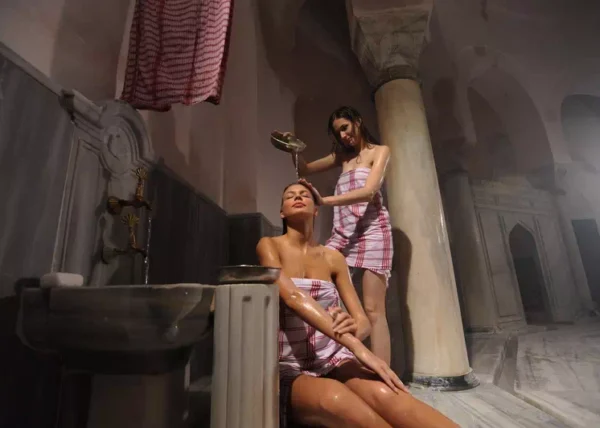
This is physical work, done for thirty to sixty minutes per guest, in a room at around 38 to 40 degrees and close to full humidity, all day. The tip goes to that person rather than into a pooled service charge, which is the argument for handing it over directly rather than leaving it anywhere.
If a second person washed your hair or gave you a separate massage, split the tip between them.
The timing, which is the part people get wrong
The sequence at a hammam ends in the sogukluk, the cooling room, where you sit with tea for twenty minutes while your body temperature settles. The attendants come through to say goodbye at that point. That is the moment.
Tipping at reception on arrival does not work. It does not reach the attendant reliably and, at a place with a fixed published rate, it reads as trying to buy something. Nobody expects it and nobody benefits from it.
Tipping at the end of the wash while still in the hot room does not work either, because you are wrapped in a wet pestemal with no pockets and the cash is in your locker. This is the practical reason the cooling room is where it happens.
The full sequence is set out in the step by step process guide.
Currency, and why lira specifically
Turkish lira, in cash. Three reasons.
Euros and dollars have to be changed, which costs the attendant time and a margin at the exchange office. Small foreign notes are worse, since exchange offices often refuse them or offer poor rates.
Card payment at reception covers the published service price, and there is no mechanism in most of these establishments to add a gratuity to it that reaches an individual attendant.
And there is no cash machine inside a hammam. Whatever you did not bring with you, you do not have.
Work out the amount before you leave your hotel and put it aside from the rest of your money, because at the end of a two hour visit in a warm building you will not be doing arithmetic.
What tipping does not buy
Worth saying plainly, since visitors sometimes arrive with the wrong model.
It does not get you a longer session. The packages are timed and the schedule is fixed.
It does not get you a gentler or harder scrub. Ask for that directly instead. The word is yavas, meaning slower or gentler, and it is understood everywhere. That is a conversation, not a transaction.
It does not get you around the rules. Age limits, gender schedules, pregnancy restrictions and health advisories are policy, and money does not move them.
What it does is recognise a piece of physical work done well, which is all it is meant to do. The wider conventions of the room are covered in the etiquette guide.
When not to tip
If the service was genuinely poor, do not tip. The one published policy in the group describes tipping as optional, and that is meant literally.
Poor here means something real. A rushed scrub, an attendant who ignored a request to ease off, a session cut short without explanation. It does not mean the kese hurt, which is what it is supposed to do, or that the room was loud, which is what a stone dome does.
If something went wrong, say so at reception rather than only withholding the tip. The historic baths speak English at the desk and would generally rather know.
Tipping elsewhere in the visit
The attendant is the only person who is customarily tipped. Reception, the cloakroom and the tea service are not.
If you booked an oil massage as a separate service with a different therapist, that is a separate tip on the same basis, since it is separate work by a different person.
For a group booking or a bridal party, where several attendants work across the group, a single larger sum handed to the senior attendant to divide is normal and easier than trying to allocate it person by person. Those bookings are covered in bridal hammam traditions.
How this compares with tipping elsewhere in Turkey
Useful context if you are working out a general approach for the trip.
Restaurants in Istanbul commonly add a service charge, and where they do not, rounding up or leaving around ten percent is normal. Taxis are typically rounded up rather than tipped by percentage. Hotel staff are tipped in cash for specific services.
The hammam sits closest to the restaurant convention in percentage terms but differs in one important way. In a restaurant the tip can go on the card. At a hammam it cannot, and that single mechanical fact is what catches out visitors who otherwise know how tipping works in Turkey.
For licensed guides, drivers and hotel staff on a longer trip, see the guide to tipping in Turkey by our sister company Turkey Itineraries.
Booking, and budgeting for the whole thing
When you plan the visit, treat the tip as part of the cost rather than an afterthought. A ninety euro ritual is realistically a hundred euro outing once the tip is in, and more if you add an oil massage, which carries its own tip.
Book ahead. The historic baths increasingly work on reservations and two of them cannot take walk ins at all. Browse the baths and reserve your session here, with instant confirmation and free cancellation up to 24 hours before.
Frequently asked questions
Do you have to tip at a Turkish hammam?
No. The one historic Istanbul bath that publishes a tipping policy states that tips are entirely optional. In practice most guests give ten to twenty percent, and attendants expect it without demanding it.
How much should you tip at a hammam in Istanbul?
Ten to twenty percent of the service price. On a 72 euro scrub and foam package that is roughly 7 to 14 euros, converted to lira and rounded to a clean note. On a 110 euro ritual it is roughly 11 to 22.
When do you give the tip?
At the end, in the cooling room, when the attendants come through to say goodbye. Not on arrival, and not during the wash, when your money is in the locker and you are in a wet wrap.
Can you add a tip to the card payment?
Generally not. Card payment at reception covers the published service price and there is usually no mechanism to route a gratuity to an individual attendant. Bring cash.
Should you tip in euros or lira?
Lira. Foreign currency has to be changed, which costs the attendant time and a margin, and small foreign notes are often refused by exchange offices. Work the amount out and set it aside before you leave your hotel.
Who do you tip at a hammam?
The attendant who worked on you, the tellak for men or the natir for women. If two people worked on you, split it. Reception, the cloakroom and the tea service are not customarily tipped.
Does tipping get you better service?
No. Sessions are timed and packages are fixed. If you want the scrub gentler, say so during it. The word is yavas and it is understood everywhere. Tipping in advance to secure better treatment is not a convention here and does not work.
Is it rude not to tip?
Not if the service was poor, and the published policy at one bath makes clear it is optional. If something genuinely went wrong, raise it at reception as well, since the historic baths speak English at the desk and would rather know than simply lose a tip.
Comments 9
[…] at the end is customary but not fixed to a set amount; the etiquette around it is explained in this guide to tipping at a Turkish hammam. Visitors travelling during Ramadan should also check hours in advance, since some baths adjust […]